Recently acquired by the global presence of the Heidelberg Group, Mick George Group has operated across the East Midlands and East Anglia for nearly 40 years building up an enviable reputation for delivering a wide range of services from earthmoving to aggregates and concrete and everything in between.
Great Billing Quarry is just one of several similar sites operated by Mick George Group and plays a major role in the day-to-day operations for the company. Centrally located just off the A45 in Northamptonshire, Mick George has recently secured planning consent to extract around 3.5 million tonnes of sand and gravel from the Great Billing site. The existing infrastructure at the site wasn’t up to the job of productively managing the throughput required by the company, and it was clear from their initial investigations that an investment in an aggregate washing plant needed to be undertaken.
The company had recently added a state of the art production plant from CDE at their Mayton Wood quarry and it was the ease of dealing with CDE’s UK strategic partner Molson Washing, and the instant productivity gains seen from the installation of the plant, which made their choice a far easier one.
“We already knew what the CDE plant was capable of with the figures we have been achieving at Mayton Wood,” Landfill, Quarry and Recycling Manager, Mark Denman, explained. “Unfortunately, the plant is not available off the shelf which meant we needed an interim solution to allow us to make a quick start on the site. Molson were able to offer us a quick fix with an AggReclaim plant which has helped us get production underway whilst the CDE plant was being built.’
AggReclaim specialise in manufacturing entry level sand and gravel recovery systems and are exclusively supplied throughout the UK by Molson Washing, part of the Molson Group. The FS+ aggregate washing plant design is a product of many years of experience within a constantly changing industry. Itis ideally suited for use across all the core quarrying, recycling and remediation industries so was an ideal fit for Mark’s team at Great Billing. The AggReclaim FS+ aggregate washing plant has been developed from the outset to be a versatile, compact and most importantly cost and energy efficient unit. Easily relocatable as projects progress, the FS+ aggregate washing plant requires almost 80% less volume of water than that of a traditional aggregate washing plant, resulting in huge cost savings as existing ponds don’t require enlarging for temporary production operations.
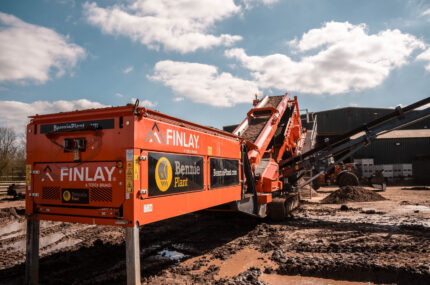
Whilst the AggReclaim aggregate washing plant, along with a Finlay 683 Supertrack inclined screen, allowed Mick George to commence extraction operations at the site, it also meant that the area where the CDE plant was to be sited could be prepared without any interruptions in productivity.
“We required an aggregate washing that would not only give us the capacity to wash a large volume of material on an hourly basis, but we also wanted it to be reliable, easy to work with and environmentally friendly too.” Mark commented. “The response we had from the Molson team over our initial enquiry at Mayton Wood has played a major part in our decision to buy from them again. The manner in which they dealt with our requirements for the first aggregate washing plant showed us they knew what we wanted and knew how to deliver a product capable of meeting the requirements at Mayton Wood. This has been played out with excellent productivity figures and a consistently high quality of material.”
With the new aggregate washing plant’s location confirmed, the Mick George team set about installing the concrete pads and associated infrastructure to feed the plant.
Manufactured in County Tyrone, Northern Ireland, the CDE aggregate washing plant has been designed and built to withstand years of punishing processing.
The modular plant is centred around an Aggmax 160 scrubbing and classification plant to clean and size the material. The feed material is initially fed into the 13m3 hopper over a set of grizzly bars, which then uses a heavy-duty Toughflex conveyor to steadily send the material out into the aggregate washing plant. Whilst the quarry is a virgin site, there is still a risk of metallic objects being fed into the plant. To reduce the risk of anything entering the aggregate washing system an overband magnet positioned above the feed conveyor removes any ferrous metals, to reduce potential damages and blockages further into the system.
The feed material is then discharged onto the Aggmax 163SR Infinity 1.5m x 4m pre-screen. The double deck rinsing screen removes the oversize and free flowing sand fractions.
Material then passes into the RX160 RotoMax log washer. Another heavy-duty unit, the RotoMax uses twin-shaft design to clean the material passing through. Retention of the material can be easily controlled through the rotation speed of the shafts ensuring optimum retention time for maximum material on material scrubbing. Any lightweight fraction is floated off and dewatered via the on board D1-43 Infinity dewatering screen.The unique spiral alignment of the paddles has been designed to reduce the shock of intermittent loads on the gearbox and bearings, and ultimately prolong component life and reduce downtime. The scrubbed material is then discharged onto a second, similarly sized Infinity sizing screen, where they are sized into their various fractions and discharged via dedicated stockpile conveyors.
The sand and fines are collected from the pre-screen, trash screen and the sizing screen, and pumped to the sand classification part of the plant. The silt is removed from the sand fraction by Hydrocyclone technology, and the sand dewatered (typical moisture content 12-15%) via the high frequency dewatering screen and discharged via dedicated stockpile conveyors.
One of the prerequisites for the plant, like the first model, was its ability to be environmentally friendly. “Like the first plant, the power and water consumption are minimal compared to the production figures we get,” Mark commented. “We have been very pleased with the low energy and water usage from both aggregate washing plants, and the figures initially quoted by Molson proved to be very accurate. We are also very happy with the build quality of both aggregate washing plants, with the first one standing up very well to dealing with the very coarse and abrasive material. Everything seems to be very well made, over engineered to a point, and more than capable of standing up to the use it is getting. Overall, we are very pleased with Molson for the effort they have put into allowing us to commence our operations early thanks to the AggReclaim aggregate washing unit, but also for another high-quality installation of the new CDE plant.’