FM Conway is a familiar sight across London and beyond. Their fleet of modern tippers are often seen across the City’s roads as are their utilities, civil engineering and surfacing gangs.
Whilst many people see their outward facing persona, behind the scenes, the business is a self-sufficient, forward-thinking contractor with an entire supply chain established to streamline their business.
Established in 1961 by Francis (Frank) Michael Conway, the business originally began operations when Frank traded his family car for a tipper truck! Frank’s single-minded determination prevailed to establish a great company with a great ethos and a passion for people.
This sentiment was continued by Frank’s son, Michael Conway MBE, who took over the company in 1981. Michael’s commitment to succeed was palpable, increasing company turnover to £1,000,000 in just four years. Michael’s forward-thinking views on the industry helped to change attitudes and deliver growth. His self-delivery philosophy was unique and his creativity for using recycled materials was unprecedented within the industry at this time. It is these visions that have developed and driven the company forward, whilst maintaining a striving family business.
As the business developed and expanded, the company opened depots as far north as Coventry and as far west as Hampshire along with a huge coverage across London and towards the south coast. This expansion saw the development of a
state-of-the-art asphalt plant on the side of the Thames, at Erith. Not only did this plant allow the company to manufacture their own asphalt, but it also took a huge step in allowing the company to self-deliver projects instead of relying on outside suppliers.
Along with the development of the plant, the location of the site also gave the company access to a dedicated wharf allowing them to import material in bulk. The drive towards a self-sustainable business saw the company develop and bring online their own bitumen plant just a few miles down the river at Gravesend. Area Manager Jim Gibb takes up the story:
“We have long held the belief that being a master of your own destiny is by far the best for the business. We can keep our material stocks high which allows us to produce material 24-7, without any need to add to the pressure on our increasingly busy road network. Over the course of seven days, we will receive five vessels ranging in capacity from 1500t barges to 5000t coasters, carrying a variety of material covering 6mm, 10mm, 14mm, 16mm and 20mm stone.”
To transfer this material from the vessels into the huge stockpile building adjacent to the asphalt plant FM Conway has installed a conveyor system to gradually fill each bay. Covered by a CCTV system, the team on the wharf can move the discharge conveyor, as each stockpile gets towards its limit, to ensure the discharge of each vessel runs smoothly and quickly.
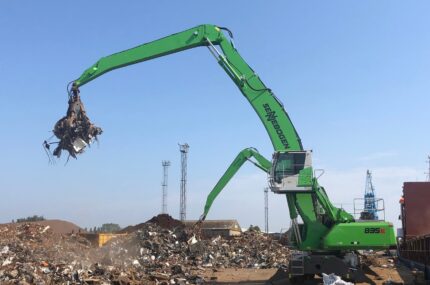
The latest addition to the FM Conway fleet of equipment is a 100 tonne Sennebogen 865E Fully Electric Hybrid recovery tracked material handler. Painted in the FM Conway colour scheme, this huge Sennebogen material handler sits on a sturdy jetty built to allow vessels to be unloaded at any height of the Thames tide.
Manufactured at the Sennebogen factory at Straubing in Bavaria, the material handler was supplied by the UK dealer, Molson Green and built up on site before being tracked onto the wharf. The Sennebogen 865E is the first of its kind to come to the UK and has allowed FM Conway to further reduce their carbon impact, since the 865E is one of Sennebogen’s fully electric models.
“We had very successfully used a similar sized Sennebogen for almost 13 years, and with a need to change the machine, we met with the Molson team to explore all possibilities for a fully electric option, designed to meet our operational needs and reduce our running costs,” Head of Major Projects Mark Whelehan explained.
“Following lengthy discussions, we settled on the Sennebogen machine we have now. Following 6 months of almost daily use, we know we have made the right choice. The Sennebogen has been flawless in use and has massively increased our productivity in the short time it has been here. On the rare occasions we have had to speak with the Molson team, their response has been second to none.”
Already having a substantial electric supply powering the asphalt plant, the installation of a suitable service for the Sennebogen 865E, although costly, wasn’t as difficult as starting from scratch. The T-shaped jetty on which the machine sits was fitted with several intermediate sockets allowing the Sennebogen 865E to travel to its final working point with ease. Once on the 150m long jetty, a fixed cable was fitted to the material handler’s self-adjusting cable reel, allowing the Sennebogen to travel freely up and down the entire length of the structure.
The Sennebogen 865E uses a dedicated 250kW electric motor to power the standard hydraulic system. Not only does this reduce any requirement for refuelling and the potential hazards this incurs, but it also dramatically reduces the maintenance required on the machine, as there are fewer moving parts to worry about. Even though the machine is based in an industrial area, prevailing winds can easily distribute engine noises down the river to nearby residential properties. The electric Sennebogen reduces noise levels to almost zero with just the traditional noise from the hydraulic system being heard from this model.
Sitting on a mechanically extendible undercarriage, the Sennebogen 865E sits snugly within the sturdy edge protection to the sides of the jetty. The large upper structure sits high enough to slew freely over the handrails to both sides of the jetty, with ample walkways and handrails ensuring safe and simple access to the components situated within. The elevating Maxcab Industry is the medium sized cab available for the larger models and gives the multiple operators ample working space and excellent vision from the seat. As part of the package a stick mounted camera gives an unimpeded view into the holds of the vessels ensuring every last bit of material is removed. This screen, along with the Sennebogen’s 360° camera screen and, Xwatch XW4 height and slew restrictor screen, still allow for a relatively uncluttered cab.
The Sennebogen 865E has a choice of boom and stick options with FM Conway choosing a B24 Port set up, giving a potential ground level reach of almost 26m. “This was the ideal set up for us, and allows us to safely service the variety of vessels we handle on a daily basis.” Mark commented. “We have chosen to fit a 3m3 Exstel clamshell which is proving to be an excellent choice for its reliability and durability.”
At the time of our visit, the wharf team were busy unloading the smallest vessel they receive, a 1500t capacity barge, which was loaded just along the coast at Northfleet where the larger coasters ferry in material from Northern Ireland.
“We can empty this vessel in around 6-8 hours depending on the tides,” the site operations team commented. “This increases to between 13 and 16 hours for the larger vessels.” The material is deposited into a large hopper situated over the conveyor, which can be remotely controlled to move up and down the line allowing the Sennebogen 865E to reach it with ease from any operating position. “We have managed to increase our hourly output to around 420 tonnes per hour, which has given us an increase in over 100,000 tonnes per annum compared to our older machine.”
“Working closely with our material providers we have built up a system which has allowed us to increase productivity whilst managing costs,” commented Jo Barker-Collins, FM Conway’s Marine and Rail Replenishment Manager. “Running vessels into the site, even from Northfleet and Tilbury, has significantly improved operational efficiencies for supplying material to the site and reduced our overall carbon footprint. Together with an increase in the use of recycled base and topping material, this has allowed us to reduce the quantity of virgin material needed at the site.”
The arrival of the Sennebogen hasn’t revolutionised the plant, but it has allowed it to maximise its potential of self-sustainability in which FM Conway is building its future on.