The recycling industry has grown massively over the past few decades as waste streams have expanded, allowing for more focused recycling of individual products.
One of these areas is vehicle recycling. Long gone are the days where a car was brought into a scrap yard and simply crushed, stacked on a trailer and shipped around the world to be thrown into a smelter. With modern vehicles containing a massive variety of materials which in themselves offer a value to the recycling company, vehicles are now being stripped down before their shells are scrapped.
Ace Car Breakers leads the way
Ace Car Breakers Ltd are one of the UK’s foremost End of Life Vehicles (ELVs) companies. Founded in 1978, the family-owned firm is located in Dartford, Kent, where they have steadily grown their business around recovery of scrap vehicles as well as buying and selling ferrous and non-ferrous metals. Their humble beginnings in the late 70s saw them taking in vehicles for scrap but also stripping them of their parts to be sold to keep other vehicles on the road. Such was the success of this very early recycling initiative that this has become a major part of the company’s business model going forward.
Today, Ace Car Breakers holds an impressive stock of parts available for online purchase and on average, handles over 15,000 cars a year.
Investing in machinery and productivity
To handle this ever-increasing volume of vehicles, Ace has invested heavily in mechanising the process. From stripping out engines, transmissions, wiring looms and other materials which can be segregated, to the feeding of the huge static shear they have installed to crush and cut up vehicle bodies.
The first stage of the stripping operations is carried out by a Hyundai equipped Powerhand VRS car dismantler. This uses a special manipulator to dissect the valuable metals and plastics from a vehicle, leaving almost a bare metal shell of a car.
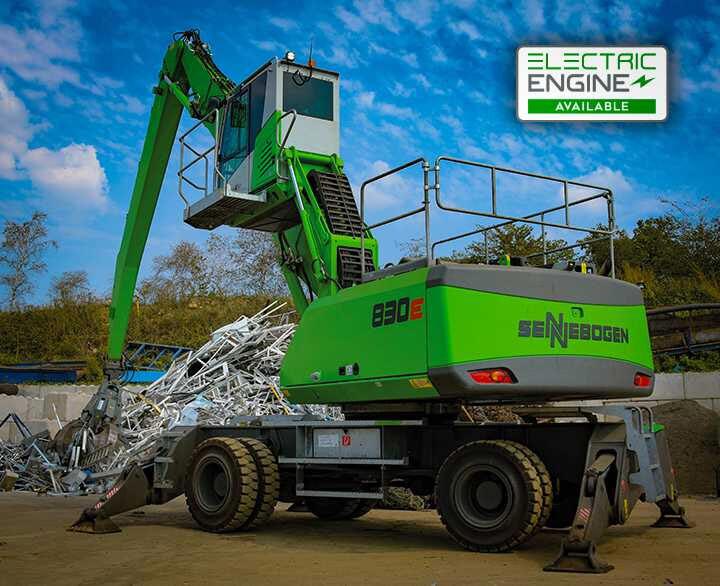
The next step of the process uses their latest addition to the fleet: one of the new Sennebogen 830E scrap handlers.
Sold and serviced in the UK by Molson Green, the 830E scrap handlers are one of over 20 dedicated scrap handling machines in the Sennebogen range, covering 9 to 40m reach.
Sennebogen delivers ‘brilliant quality’
Built at the company’s plant in Straubing, Germany, the 830E scrap handler joins a similar model already working at Ace’s Swanscombe recycling yard. “We have been using Sennebogen scrap handlers for several years and have found them to be brilliant quality,” Director Henry Arnold commented. “We took the first 830E in 2018, and it has proved itself time and time again to be a reliable performer, more than suited to delivering high levels of productivity for our operation.”
The new 830E scrap handler has been purchased to add production gains within the busy operation, leaving the older machine to concentrate on handling incoming vehicles. “With just the one scrap handler we were slowing down the processing of the vehicles. We were having to use the machine to load a bulker or stack vehicles once they’ve been stripped of parts,” Henry commented. “Having two scrap handlers has streamlined our operations massively, and increased the volume of vehicles we process and the scrap we can ship out.”
Your scrap handlers your way
The 830E has been supplied on a wheeled undercarriage which is ideal for Ace’s concreted yard. The undercarriage uses a set of four, independently controlled outriggers to give the machine a huge 24m2 footprint. This allows it to easily and safely work at full reach, with a full grab, anywhere within its working radius. The latest updates to the Sennebogen wheeled undercarriage have added further enhancements to the access. These include substantial galvanised steps and grab handles, allowing safe access to the upper structure.
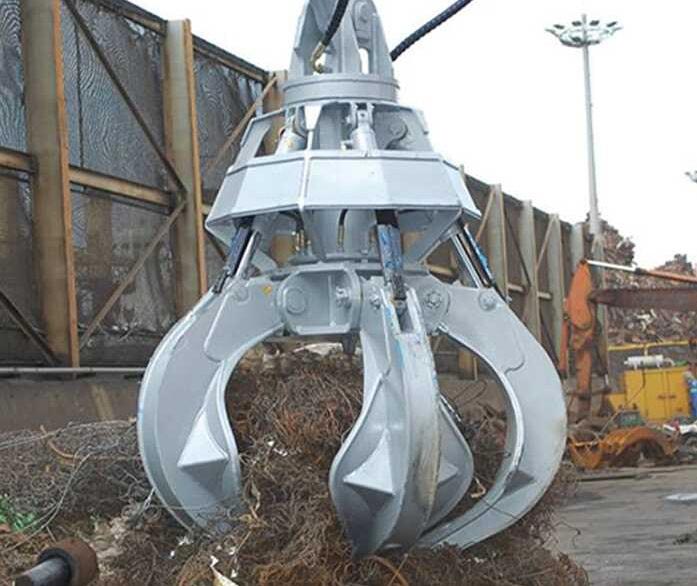
Like all top manufacturers, Sennebogen offers the 830E scrap handlers with a choice of boom and stick options to suit a variety of operations. Ace’s machine has been delivered with K17 equipment, which comprises a 9.8m straight boom and 7.5m straight grab stick that carries a 600-litre orange peel grab.
Ergonomic design for ease, safety and comfort
The 830E’s upper structure has been designed to allow ease of access when it comes to servicing too. The offside of the machine opens in one to reveal the Cummins B6.7 engine and cooling pack. Whilst all daily checks can be completed through the in-cab monitor, the points are also easily accessible once the gull-wing canopy is opened if you prefer manual checks. Unlike many manufacturers, the tried and tested Cummins engine uses its compact aftertreatment module to reduce the space needed to install the engine. This reduces the need for any increase in bodywork height, leaving a low profile on the machine’s upper structure.
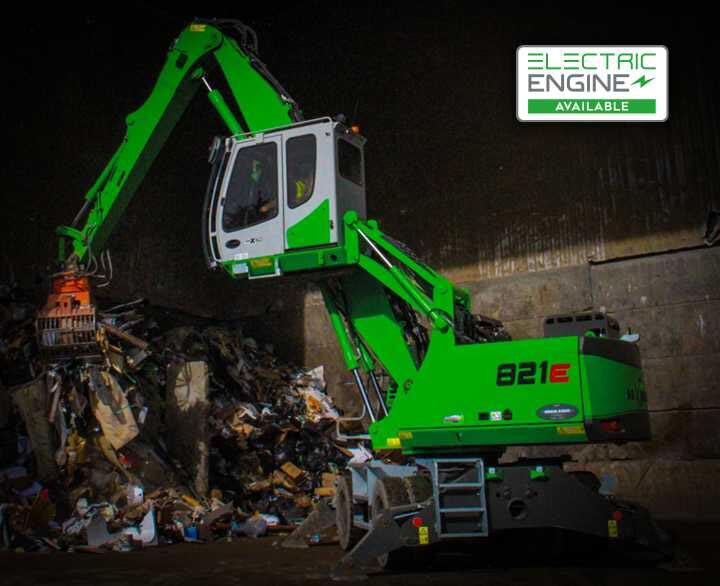
The Sennebogen MaXcab uses an E270 cab riser which smoothly increases the eyeline of the operator from 3.3m up to 4.6m. This enables them not only to see a larger working area around them, but also helps them see into the bodies of the trucks they load on a daily basis. The increase in cab height is also beneficial when loading the huge Lefort shear, which is in constant use. “The shear has played a huge role in driving our productivity,” Henry explains. “The Sennebogen scrap handlers work perfectly with the shear, which is positioned in a way that the machine can load it, and clear the shearings away to a stockpile, without having to move.”
Optimum recycling efficiency
Once each vehicle has been drained of oils and fluids, and stripped of its salvageable components, it is transferred to the final processing area, where the Sennebogen feeds the Powerhand equipped Hyundai. Radiators, engine, gearbox and axles are removed and segregated for further recycling, while any plastic or fabric products are set aside in a different bin.
The 38t Sennebogen removes the vehicle’s shell to a waiting pile of scrap. From this pile, the cars are steadily fed into the huge Lefort shear. This uses huge hydraulic rams to fold and flatten the car into a fraction of its original size, before it is pushed through the shear blades at the far end of the machine and dropped onto the floor in a pile of easily handled scrap.
Maximum reach minimises movement
As the shear is going through its cycle, the Sennebogen turns back to moving and stacking the vehicles, before it picks up the shearings to place on a large pile. “The 17m reach on the 830E scrap handlers allows us to keep the machine almost static as it can reach the shear, Powerhand and stockpiles from one position,” Henry comments. “The only time we have to move it is when we have tippers in to remove the scrap and transfer it to the nearby London Scrap Terminal.”
The 830 is quickly relocated when the next truck arrives, with the four stabilisers lifted just clear of the ground before it is driven next to the processed metal pile. Stabilisers down and cab elevated once again, the truck is positioned, and the loading commenced immediately. In just a few short minutes, the truck is loaded and off to the quayside just a few miles up the road.
“We are very happy with the added productivity we have gained with the new arrival,” Henry explains. “We knew the robust build and reliability of Sennebogen scrap handlers was right for us, and with the excellent service we have from Stuart Butler and the Molson servicing team, we know that we have the backup behind us if we need it.”